1.1-1.2Free
What is software development? The SDLC
Your guide: Miss HiraExplains computers with chai, cricket and your phone.
What is software development? The SDLC
Every app on your phone was built in steps.
Which steps? Let us find out.
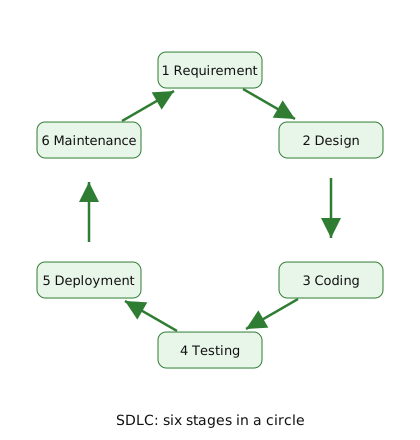
Six stages, one circle.
1 · What is software development?
Software development is a step-by-step process. It turns user needs into a software product.
It means writing code, testing it, and fixing the problems that appear.
The stages run from analysis to design, coding, testing and deployment.
2 · SDLC and frameworks
The SDLC is a framework. It shows how a team builds an application, from idea to deployment and maintenance.
Its aim is high-quality software that meets customer needs, stays within time and cost, and works well.
A framework in software is a standard, reusable set of ideas, practices and tools. It gives a ready base, so developers write only the code their application needs.
Example in the book: the Django framework has ready features for user login, database handling and page templates.
3 · The six stages
Requirement: find out what the software must do. Talk to users and stakeholders. Methods: interviews and surveys, observation, document review.
Requirements are functional (what the system does) or non-functional (how well it does it: speed, reliability, security).
Library example: registering users, borrowing books and managing the inventory are functional. Serving 1000 users at once and being available 99.9 percent of the time are non-functional.
Design: decide how the software will look and work. Diagrams, models, architecture and clear specifications. The book compares it to a house blueprint.
Coding: programmers turn the design into a programming language. Testing: check for bugs. Types: functionality, performance, compatibility.
Deployment: installation, configuration, then testing in the real world. Maintenance: ongoing updates and fixes.
Step 1 / 7
Notes, short questions and MCQs
Read the full notes: key terms, model answers and MCQs with answers
What is software development? The SDLC
Every app on your phone was built in steps.
Which steps? Let us find out.
Six stages, one circle.
1 · What is software development?
Software development is a step-by-step process. It turns user needs into a software product.
It means writing code, testing it, and fixing the problems that appear.
The stages run from analysis to design, coding, testing and deployment.
2 · SDLC and frameworks
The SDLC is a framework. It shows how a team builds an application, from idea to deployment and maintenance.
Its aim is high-quality software that meets customer needs, stays within time and cost, and works well.
A framework in software is a standard, reusable set of ideas, practices and tools. It gives a ready base, so developers write only the code their application needs.
Example in the book: the Django framework has ready features for user login, database handling and page templates.
3 · The six stages
Requirement: find out what the software must do. Talk to users and stakeholders. Methods: interviews and surveys, observation, document review.
Requirements are functional (what the system does) or non-functional (how well it does it: speed, reliability, security).
Library example: registering users, borrowing books and managing the inventory are functional. Serving 1000 users at once and being available 99.9 percent of the time are non-functional.
Design: decide how the software will look and work. Diagrams, models, architecture and clear specifications. The book compares it to a house blueprint.
Coding: programmers turn the design into a programming language. Testing: check for bugs. Types: functionality, performance, compatibility.
Deployment: installation, configuration, then testing in the real world. Maintenance: ongoing updates and fixes.
Key terms
- SDLC
- The framework of stages used to build software.
- Functional requirement
- What the system should do.
- Non-functional requirement
- How well the system should perform.
- Deployment
- Making the software available to users.
Short questions with model answers
Q1. Book short question 1: differentiate functional and non-functional requirements.
Functional: the specific behaviour of the system; what it should do; tied to user tasks. Non-functional: quality and constraints; how it should perform; tied to speed, usability and reliability.
Common mistakes
✗ “Testing is the last stage of the SDLC.”
✓ Testing is stage 4. Deployment and maintenance come after it.
MCQs
1. The main purpose of the SDLC is to:
- (a) deliver high-quality software within time and cost
- (b) design websites only
- (c) manage databases
- (d) build hardware
Show answer
(a) Book MCQ 1.
2. A requirement about system performance is:
- (a) non-functional
- (b) functional
- (c) technical
- (d) operational
Show answer
(a) Book MCQ 2.
3. The role of a framework is to:
- (a) give a structured base with ready parts
- (b) write all code from scratch
- (c) manage hardware
- (d) do manual testing
Show answer
(a) Book MCQ 3.
4. Which is a method of requirement gathering?
- (a) Document review
- (b) Unit testing
- (c) Installation
- (d) Debugging
Show answer
(a) The book lists interviews and surveys, observation, and document review.
Quick revision
- Six stages: requirement, design, coding, testing, deployment, maintenance.
- Functional: what. Non-functional: how well.
Free right now. No ads. Tell us what to fix.