17.1Free
Group 2: properties and trends
Your guide: Miss SanaCounts atoms the way you count rupees: carefully.
Group 2: properties and trends
Fireworks glow in bright colours. Many of those colours come from Group 2 metals.
Why do these five metals behave alike? Let us see.
Electrons, trends, reactivity.
1 · Who are they?
Group 2 elements are s block elements. They are also called the alkaline earth metals.
They are metals that are less reactive than the alkali metals and more reactive than the transition metals.
Calcium and magnesium are among the eight most common elements in the earth crust.
Beryllium makes copper alloys harder for aerospace. Magnesium is an important part of chlorophyll.
Magnesium, calcium, strontium and barium give bright flame colours in fireworks.
2 · The same outer shell
All five elements have two electrons in the outermost s subshell. This is written ns2.
So they show similar chemical properties. But the properties change from top to bottom.
Beryllium [He] 2s2, magnesium [Ne] 3s2, calcium [Ar] 4s2, strontium [Kr] 5s2, barium [Xe] 6s2.
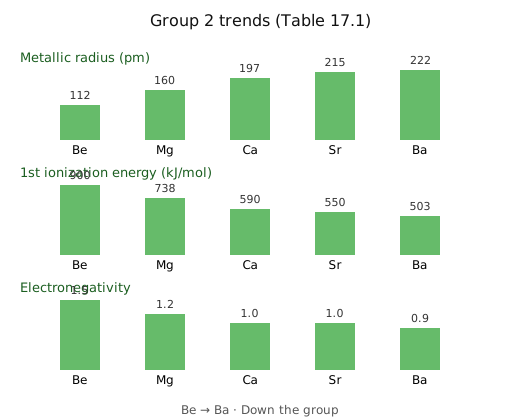
3 · Trends in Table 17.1
Metallic radius in pm: Be 112, Mg 160, Ca 197, Sr 215, Ba 222. It grows down the group.
Ionic radius of M2+ in pm: 31, 65, 99, 113, 135. It also grows.
First ionization energy in kJ/mol: 900, 738, 590, 550, 503. It falls down the group.
Electronegativity falls from 1.5 to 0.9.
Melting point and density depend on how the metal atoms pack. They do not change in a smooth line.
4 · Why reactivity grows
A Group 2 atom loses its two outer electrons. It becomes a stable M2+ ion.
Going down, the atom gets bigger. The shielding effect grows. The ionization energy falls.
So electrons leave more easily and reactivity grows from Be to Ba.
Reactivity series, least to most reactive:
Be < Mg < Ca < Sr < Ba
Step 1 / 7
Notes, short questions and MCQs
Read the full notes: key terms, model answers and MCQs with answers
Group 2: properties and trends
Fireworks glow in bright colours. Many of those colours come from Group 2 metals.
Why do these five metals behave alike? Let us see.
Electrons, trends, reactivity.
1 · Who are they?
Group 2 elements are s block elements. They are also called the alkaline earth metals.
They are metals that are less reactive than the alkali metals and more reactive than the transition metals.
Calcium and magnesium are among the eight most common elements in the earth crust.
Beryllium makes copper alloys harder for aerospace. Magnesium is an important part of chlorophyll.
Magnesium, calcium, strontium and barium give bright flame colours in fireworks.
2 · The same outer shell
All five elements have two electrons in the outermost s subshell. This is written ns2.
So they show similar chemical properties. But the properties change from top to bottom.
Beryllium [He] 2s2, magnesium [Ne] 3s2, calcium [Ar] 4s2, strontium [Kr] 5s2, barium [Xe] 6s2.
3 · Trends in Table 17.1
Metallic radius in pm: Be 112, Mg 160, Ca 197, Sr 215, Ba 222. It grows down the group.
Ionic radius of M2+ in pm: 31, 65, 99, 113, 135. It also grows.
First ionization energy in kJ/mol: 900, 738, 590, 550, 503. It falls down the group.
Electronegativity falls from 1.5 to 0.9.
Melting point and density depend on how the metal atoms pack. They do not change in a smooth line.
4 · Why reactivity grows
A Group 2 atom loses its two outer electrons. It becomes a stable M2+ ion.
Going down, the atom gets bigger. The shielding effect grows. The ionization energy falls.
So electrons leave more easily and reactivity grows from Be to Ba.
Reactivity series, least to most reactive:
Be < Mg < Ca < Sr < Ba
Key terms
- Alkaline earth metals
- Another name for the Group 2 metals.
- s block element
- An element whose outer electrons are in an s subshell.
- Ionization energy
- Energy needed to remove an electron from an atom.
- Shielding effect
- Inner electrons reduce the pull of the nucleus on outer electrons.
- Reactivity series
- A list of metals from least to most reactive.
Short questions with model answers
Q1. Quick Check 17.1 (c): explain why Group 2 elements are reactive.
Each atom has two electrons in its outer ns2 subshell. It loses them and forms a stable M2+ ion with a +2 charge. This makes it react quickly with other substances.
Q2. Why does reactivity increase down the group?
Size and shielding effect increase. Ionization energy decreases. Removing electrons becomes easier, so reactivity increases.
Common mistakes
✗ “Reactivity falls down Group 2.”
✓ It rises. Barium is the most reactive.
✗ “Ionization energy rises down the group.”
✓ It falls, from 900 to 503 kJ/mol.
✗ “Melting point falls smoothly down the group.”
✓ No. The book says it depends on atom packing. The values are 1287, 650, 842, 777, 727 °C.
MCQs
1. The outer electron pattern of all Group 2 atoms is:
- (a) ns2
- (b) ns1
- (c) np2
- (d) nd2
Show answer
(a) Two electrons in the outer s subshell.
2. Which Group 2 metal has the largest metallic radius in Table 17.1?
- (a) Barium, 222 pm
- (b) Beryllium, 112 pm
- (c) Calcium, 197 pm
- (d) Magnesium, 160 pm
Show answer
(a) The radius grows down the group.
3. Which is the least reactive?
- (a) Beryllium
- (b) Magnesium
- (c) Calcium
- (d) Barium
Show answer
(a) Be < Mg < Ca < Sr < Ba.
4. Down Group 2 the first ionization energy:
- (a) decreases
- (b) increases
- (c) stays the same
- (d) first rises, then falls
Show answer
(a) From 900 to 503 kJ/mol.
Quick revision
- All Group 2 atoms have ns2 outer electrons and form M2+ ions.
- Radius grows and ionization energy falls down the group.
- Reactivity: Be < Mg < Ca < Sr < Ba.
Free right now. No ads. Tell us what to fix.