1.1Free
Complex numbers: real part, imaginary part, conjugate and modulus
Your guide: Sir AhmedSays brackets have saved more marks than any calculator.
Read: a number whose square is −1
Try to solve x2 + 1 = 0.
No real number works. Its square is never negative.
So mathematicians made a new kind of number. Let us meet it.
1 · The imaginary number i
From x2 + 1 = 0 we get x2 = −1. So x = ±√−1.
√−1 is not a real number. The book calls it an imaginary number.
We write it as i. It is read as iota.
So i2 = −1.
2 · What is a complex number?
A number of the form z = a + ib is a complex number. Here a and b are real numbers.
Examples from the book: 3 + 4i, 2 − (5/7)i and −7 − 2i.
The set of all complex numbers is written ℂ.
3 · Real part and imaginary part
In z = a + ib, a is the real part. It is written Re z.
b is the imaginary part. It is written Im z.
For z = 3 + 4i: Re z = 3 and Im z = 4.
A non-zero real number times i is imaginary. Examples: 2i, −3i, √5 i, −(11/2)i.
Every real number is a complex number. Its imaginary part is 0.
4 · The conjugate
The conjugate of a + ib is a − ib. It is written z̄.
5 − 4i is the conjugate of 5 + 4i. −2 − 3i is the conjugate of −2 + 3i.
A real number is its own conjugate.
5 · The Argand diagram
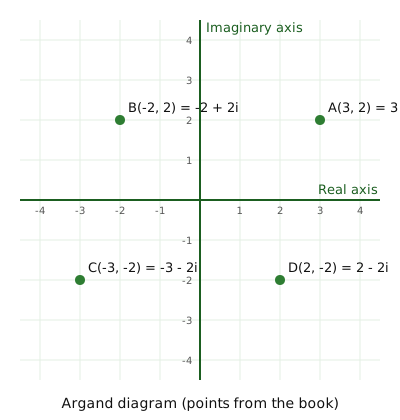
Every complex number is one point on the plane. No two numbers share a point.
The x-axis is the real axis. The y-axis is the imaginary axis.
The number x + iy is the point (x, y). This plane is the complex plane.
Book points: A is 3 + 2i, B is −2 + 2i, C is −3 − 2i, D is 2 − 2i.
6 · The modulus
The modulus of x + iy is √(x2 + y2). It is written |x + iy|.
It is the distance from the origin (0, 0) to the point.
Book example: z = −2 + i gives |z| = √5.
Step 1 / 7
Notes, short questions and MCQs
Read the full notes: key terms, model answers and MCQs with answers
Read: a number whose square is −1
Try to solve x2 + 1 = 0.
No real number works. Its square is never negative.
So mathematicians made a new kind of number. Let us meet it.
1 · The imaginary number i
From x2 + 1 = 0 we get x2 = −1. So x = ±√−1.
√−1 is not a real number. The book calls it an imaginary number.
We write it as i. It is read as iota.
So i2 = −1.
2 · What is a complex number?
A number of the form z = a + ib is a complex number. Here a and b are real numbers.
Examples from the book: 3 + 4i, 2 − (5/7)i and −7 − 2i.
The set of all complex numbers is written ℂ.
3 · Real part and imaginary part
In z = a + ib, a is the real part. It is written Re z.
b is the imaginary part. It is written Im z.
For z = 3 + 4i: Re z = 3 and Im z = 4.
A non-zero real number times i is imaginary. Examples: 2i, −3i, √5 i, −(11/2)i.
Every real number is a complex number. Its imaginary part is 0.
4 · The conjugate
The conjugate of a + ib is a − ib. It is written z̄.
5 − 4i is the conjugate of 5 + 4i. −2 − 3i is the conjugate of −2 + 3i.
A real number is its own conjugate.
5 · The Argand diagram
Every complex number is one point on the plane. No two numbers share a point.
The x-axis is the real axis. The y-axis is the imaginary axis.
The number x + iy is the point (x, y). This plane is the complex plane.
Book points: A is 3 + 2i, B is −2 + 2i, C is −3 − 2i, D is 2 − 2i.
6 · The modulus
The modulus of x + iy is √(x2 + y2). It is written |x + iy|.
It is the distance from the origin (0, 0) to the point.
Book example: z = −2 + i gives |z| = √5.
Key terms
- Imaginary number
- A number like 2i or −3i: a non-zero real number times i.
- Real part and imaginary part
- In a + ib, the real part is a and the imaginary part is b. Note: b is a real number, without the i.
- Conjugate
- Change the sign of the imaginary part: a + ib becomes a − ib.
- Complex plane
- The plane with a real axis and an imaginary axis. The diagram is the Argand diagram.
- Modulus
- The distance of the point from the origin: |x + iy| = √(x2 + y2).
Short questions with model answers
Q1. Write the real part and imaginary part of 3 + 4i.
It has the form a + ib with a = 3 and b = 4. So Re z = 3 and Im z = 4.
Q2. Find |z| if z = (1 + 2i)2 / (2 − i).
First z = −2 + i (see the solver). Then |z|2 = (−2)2 + 12 = 5. So |z| = √5.
Common mistakes
✗ “In 3 + 4i the imaginary part is 4i.”
✓ The book says Im z = 4. The imaginary part is the real number 4.
✗ “(1 + 2i)2 = 1 + 4i + 4.”
✓ 4i2 = −4, not +4. So (1 + 2i)2 = −3 + 4i.
✗ “The conjugate of −2 + 3i is 2 − 3i.”
✓ Only the sign of the imaginary part changes. The conjugate is −2 − 3i.
MCQs
1. What is i2?
- (a) 1
- (b) −1
- (c) i
- (d) 0
Show answer
(b) The book defines i as √−1, so i2 = −1.
2. For z = 3 + 4i, what is Im z?
- (a) 3
- (b) 4i
- (c) 4
- (d) 7
Show answer
(c) Im z is the number b in a + ib. Here b = 4.
3. What is the conjugate of 5 + 4i?
- (a) −5 + 4i
- (b) 5 − 4i
- (c) −5 − 4i
- (d) 4 + 5i
Show answer
(b) The book gives 5 − 4i as the conjugate of 5 + 4i.
4. Which point is the number −3 − 2i on the Argand diagram?
- (a) (3, 2)
- (b) (−2, 2)
- (c) (−3, −2)
- (d) (2, −2)
Show answer
(c) x + iy is the point (x, y). Here x = −3 and y = −2. The book calls this point C.
5. What is |3 + 4i|?
- (a) 7
- (b) 5
- (c) 25
- (d) 1
Show answer
(b) |3 + 4i| = √(32 + 42) = √25 = 5.
6. Which statement is true?
- (a) Every real number is a complex number.
- (b) No real number is a complex number.
- (c) i is a real number.
- (d) A real number has no conjugate.
Show answer
(a) The book's note: every real number is a complex number with 0 as its imaginary part.
Quick revision
- A complex number is a + ib with real a, b and i2 = −1.
- The conjugate flips the sign of the imaginary part.
- The modulus √(x2 + y2) is the distance from the origin.
Free right now. No ads. Tell us what to fix.